

Fabric offcuts, Moroccan rugs, and an idea that became iconic: from her Paris studio, Calla Haynes has reinvented the babouche as a contemporary object of desire, bringing together craftsmanship, upcycling and slow fashion.
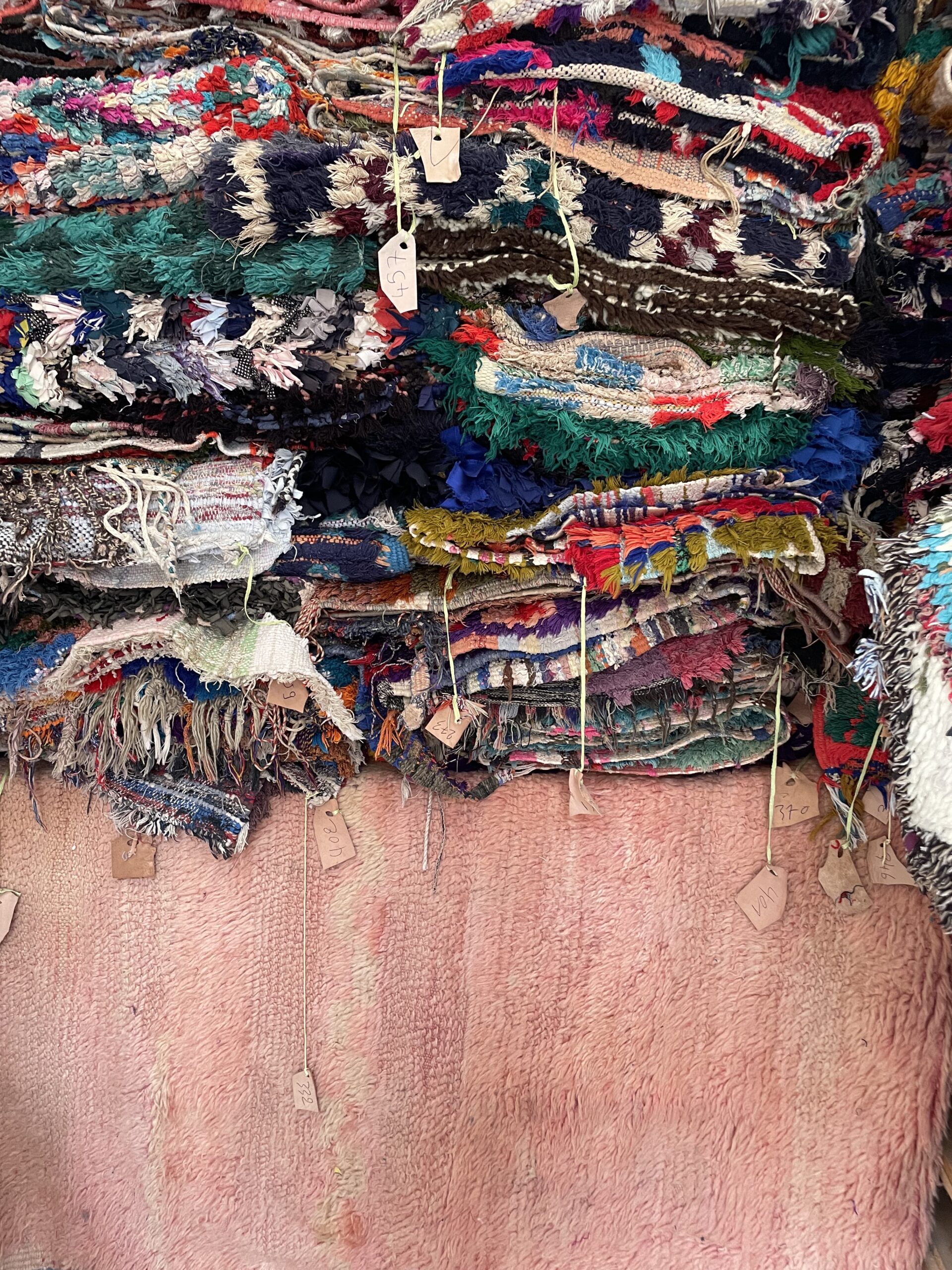
Before it became a babouche brand, Calla was a ready-to-wear label. Founded in 2010 by Canadian designer Calla Haynes, who is based in Paris and previously worked alongside Olivier Theyskens at Rochas and Nina Ricci, the label was known for its original prints and textiles. When that first chapter came to an end, Haynes was left with piles of fabrics, and one simple question: what could she possibly do with all these materials? The answer came almost by accident. Fascinated by Moroccan Boucherouite rugs, Haynes began collaborating with women weavers and artisans in Marrakech. Out of that encounter came an unexpected object: babouches crafted from recycled Berber rugs. Today, these entirely handmade, one-of-a-kind shoes can be found everywhere from Tokyo to Reykjavík. A brand built outside the fashion calendar, growing at its own pace: slowly, joyfully and with people at its heart.
Calla was born around one very specific object: the babouche. Why?
It happened almost by accident. I’m a textile designer by training and I was working for major luxury houses. At the same time, I had my own ready-to-wear label, known mostly for its prints. When I closed that business, I was left with a huge archive of fabrics that I had designed myself. I couldn’t bring myself to throw them away. It also made me realise just how much waste exists in the textile industry. I’ve always found Moroccan Boucherouite rugs incredibly beautiful. I got in touch with a group of women in Morocco and, for two years, we worked remotely. I would send fabrics; they would weave rugs. I completely fell in love with their creativity, their spontaneity and the way they could work with every kind of material. I exhibited the rugs, but quickly realised that people don’t buy rugs the way they buy fashion. So I started wondering what smaller object could communicate that same love of Moroccan craftsmanship. That’s when I had the idea of bringing together Boucherouite rugs and babouches. We made sixty pairs for a trunk show in Toronto. They sold out in one hour. That’s when I thought there might be something there.
When did you realise the babouche belonged in a contemporary wardrobe?
Very quickly. As soon as I saw the first photographs, I loved them. Having worked in luxury fashion, I knew there were customers who would appreciate an entirely handmade object. Every single pair is different, and I loved the idea of offering something that is genuinely unique.
Do you still work with reclaimed textiles?
Yes. At first, we only used vintage rugs. That was already a form of recycling, since Boucherouite rugs themselves are woven from reclaimed textiles. We simply give them another life. Today we also collect fabric leftovers from designers and luxury houses, mainly in Paris and Italy. They’re sent to Morocco to be woven into new textiles. Our monochrome styles, for example, are made from these reclaimed fabrics.
How do you source them?
Through contacts, but sometimes in much less glamorous ways. I used to live near the Sentier district in Paris and every evening I’d see bags full of discarded fabric. I’ve gone through bins before. It’s not the chicest story to tell, but it’s shocking to see how much is thrown away. When I was freelancing for luxury brands, people would sometimes tell me, “We’ve got seventy boxes going to the incinerator, do you want them?” Of course I did. Thankfully, I think there’s much greater awareness today than there was ten years ago.
You work between Paris and Marrakech. How do you build that relationship without falling into cultural appropriation?
I may have brought these different traditions together, but the creativity comes from the artisans themselves. I give them materials and ideas, but I never dictate what they should do. My goal has always been to bring their craftsmanship onto an international stage. We’ve worked with the same artisan, Ahmed, since the very beginning. He started alone. Today, his brother and son work alongside him. This year he bought a house and expanded his workshop. Seeing the whole team doing well means a great deal to me.
Do you also enjoy pushing them towards new forms?
Absolutely. At first, we worked with very traditional silhouettes. I try to introduce more fashion-forward shapes. We developed a tabi, which isn’t Moroccan at all. It was incredible to watch our shoemaker understand its construction simply from photographs. I like giving them challenges. They always find solutions.
Do you introduce new collections every season?
No. After spending years in the fashion industry, I wanted to embrace slow fashion. We’ve kept the same core styles from the beginning. We might introduce one or two new silhouettes each year, but what really changes are the textures, the rugs and the colours. There isn’t really such a thing as a season at Calla.
Who wears Calla babouches?
It’s incredibly inclusive. We make every style from size 35 to 46. Our customers are all ages and live all over the world: Japan, Italy, the United States, Korea, across Europe. I think they share a curiosity about travel, colours and texture. And honestly, you can wear an entirely black outfit, slip on a pair of babouches, and your look is complete.
What have Moroccan artisans taught you?
To stay open and to embrace surprise. Every time we receive a shipment, it feels like Christmas. I choose the rugs, but then Ahmed and his team decide how to position them. Every single time, I’m surprised. I truly admire their eye.
Why do you think people love your babouches so much?
I think they fall in love with the look first. Then they discover the story behind them: the recycling, the craftsmanship, the people who make them. That becomes important too.
Yet you had no previous connection to Morocco?
No. I’ve simply always admired people who work with their hands. I’ve collaborated with artisans in France, and I believe Moroccan craftsmanship is just as noble and extraordinary. It’s a real privilege to work with them.
Is there another city that feeds your imagination?
Tokyo. I lived there when I was twenty. I still dream about Tokyo—it always makes me happy. We have many customers there and regularly organise pop-ups with our Japanese agent. The Japanese love babouches. I’d love to go back.
If you had to create another object, what would it be?
Everyone asks me that! We’ve experimented with hats, but it wasn’t quite right. What interests me most is continuing to work with this material. Recently I developed a furniture collection with a friend in Toronto. We recycle fabrics to make benches and stools. It’s another way of extending the story.
You launched the brand almost at the same time your daughter was born.
Yes, exactly. The babouches and my daughter arrived at the same time. I’m grateful that this business allows me to have a real life outside work. That’s not something that’s easy to find in fashion. When I closed my first brand, it felt like mourning. This project happened almost by accident, but it’s been an incredible gift. I’m deeply grateful that people continue to embrace it. Most of all, I’m proud of our artisans. I send Ahmed pictures all the time: “Look, the babouches are in Japan! They’re in Canada! Now they’re in Iceland!” I don’t think he ever imagined shoes made in Morocco would end up being worn in Iceland. We’re all incredibly proud of that.