
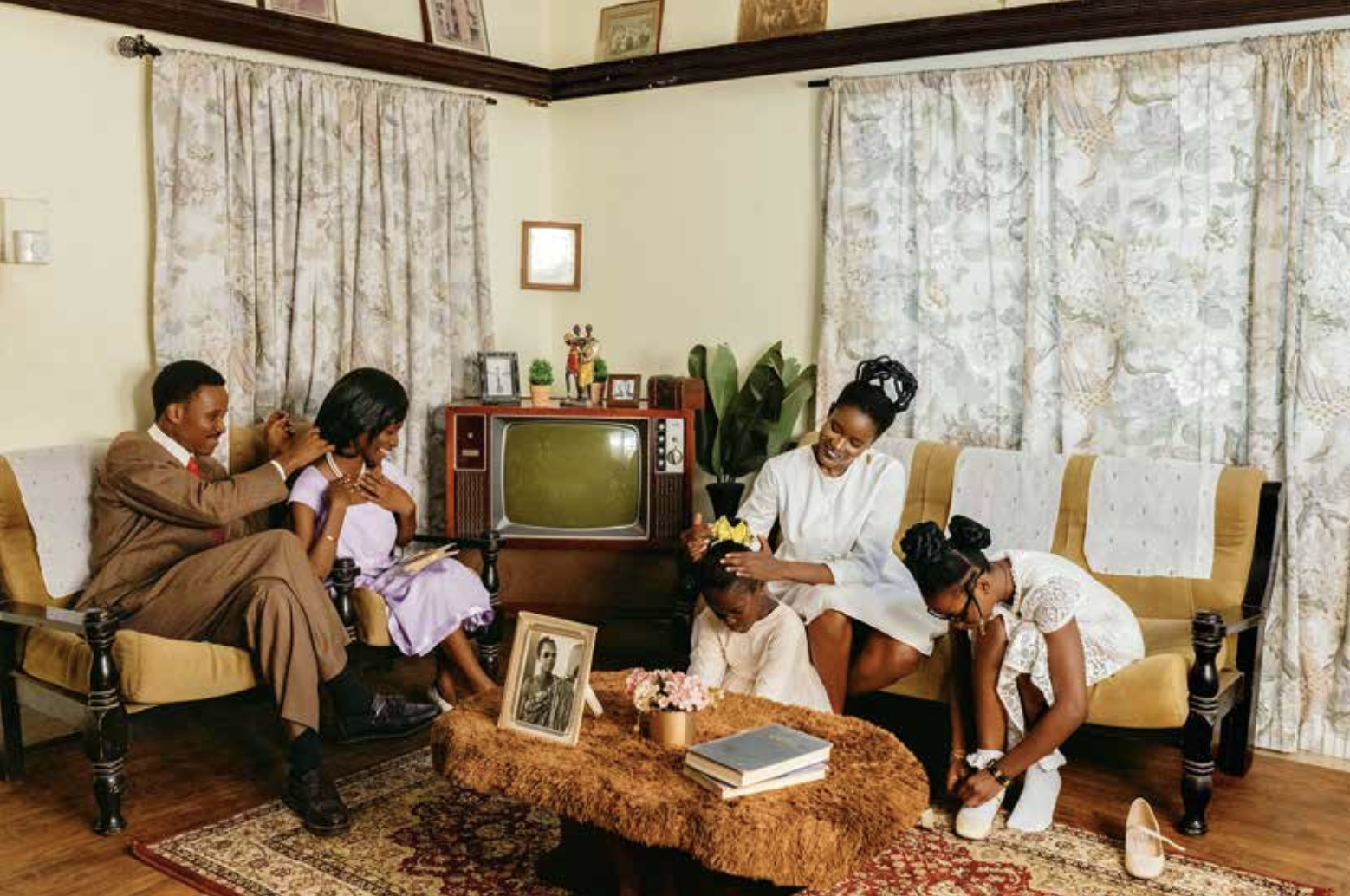
At the Rencontres d’Arles, the exhibition Ghana! Dreaming Independence, 1957–1976 traces the way a newly independent country shaped its identity through images. Its curator, photography historian Damarice Amao, speaks to CITY about a long-term research project spanning official archives, photobooks, banknotes and contemporary perspectives.
It is one of the liveliest and most stimulating exhibitions of this year’s Rencontres d’Arles. Presented at the Palais de l’Archevêché, Ghana! Dreaming Independence, 1957–1976 explores a decisive moment in the country’s history: the period beginning in 1957, when the former British colony of the Gold Coast became the first sub-Saharan African state to gain independence. Photographs, books, films, stamps and banknotes reveal how a young nation represented itself, imagined itself and presented itself to the world. This official history is echoed by the voices of contemporary artists, invited to question Ghana’s visual memory and the promises of independence. An art historian and curator at the Musée national d’art moderne – Centre Pompidou, Damarice Amao built the exhibition from scattered documents, bringing to light the connections between images, eras and narratives. We met her.
The exhibition spans several decades of Ghanaian photographic history. What struck you most when bringing these different generations into dialogue?
At the outset, this was not an already established subject. There were no organised archives and no clearly defined body of work. The entire challenge of the research was therefore to build a narrative from quite disparate elements: the story of Paul Strand, the history of photobooks, James Barnor’s photographs, but also stamps and banknotes… Then it was necessary to reconnect all of this with the current generation, which is working with this visual memory.
My role as a researcher, and the way I work, involves creating connections and formulating hypotheses. These are either confirmed or not, and eventually take shape within the exhibition. What initially seemed to me to be a very historical subject ultimately acquired its full visual meaning in the exhibition space. That was the real challenge.
One of the exhibition’s strengths lies in the dialogue between archives and contemporary creation. Why did you choose not to tell this story in a strictly chronological way?
I am an art historian and a photography historian specialising in the interwar period, so in what we might call modern or earlier periods. But I always speak about earlier periods in order to better address the present, particularly because I deal with sociocultural and political issues. In the case of Ghana, the questions of decolonisation, North-South relations and what happens after colonisation remain entirely relevant today. It was therefore important for me to speak about this history in the present.
From a curatorial perspective, I am not always in favour of contemporary extensions, and I believe one has to be quite cautious. But through working in the field and speaking with different artists, it became clear to me that certain works could provide genuine counterpoints. They also help to break the rhythm of the exhibition: I did not want to show only framed black-and-white prints. I chose Dreaming Independence as the subtitle. That dream and those projections, developed at the moment of decolonisation, remain challenges and subjects of reflection today. They also inspire a certain nostalgia among current generations.
Beyond their aesthetic power, what do these photographs tell us about the construction of the country?
Most of the photographs I present are, in a sense, official images. I fully accept that I am showing projections, narratives and even forms of propaganda. Certain sections of the exhibition nevertheless offer a more intimate and less standardised vision of Ghanaians. This political and social revolution was also experienced privately, and these are not necessarily things one finds in official narratives. But the exhibition is above all about the way a country projects its image, whether that image is viewed positively or negatively. This is also part of the truth of a state in the process of being built. There is the real situation, complex and multifaceted, and then there is this desire to present oneself to the world. This projection fully belongs to the geopolitical reality of decolonisation: it shows how a nation stages and asserts its national project. That is truly what the exhibition is about.

Portrait by Marguerite Bornhauser
Is there a work or an image you would like visitors to remember after leaving the exhibition?
It is very difficult, because every image was selected with great precision and care. But I might mention the video shown in the first room, which enters into dialogue with Paul Strand’s work. It reflects this desire to speak about history in the present and to involve contemporary artists. I did not want Ghanaians to appear only as small figures, however beautifully represented, in black and white and frozen on photographic paper. In this video, we invited several people to look through books devoted to Ghana, including Paul Strand’s, and to comment on what they saw. They speak about their country, their relationship to these archives and to their visual heritage. It is perhaps this contemporary, present-day voice that I would like people to remember.
This exhibition is the culmination of several years of research. When did the project begin?
I received a grant for this project in 2020, but then Covid happened. I also worked on several other projects as part of my role at the Centre Pompidou, which delayed the schedule somewhat. I nevertheless continued working on this exhibition throughout, and it became a long-term research project. What we see in Arles ultimately represents only the tip of the iceberg. I could have presented many more things, and there is still a great deal of research to be done. The exhibition is only a sample.
After spending so much time immersed in this photographic history, what questions continue to stay with you?
They are sometimes quite specific questions, which are not necessarily visible in the exhibition. I would, for example, like to continue researching the relationship between Ghana’s Ministry of Information and the London agency that designed the layouts of certain publications, in order to better understand the process through which these books were produced. There are also still archives to be found relating to certain books devoted to Ghana. In the first room, a display case also presents banknotes designed using photographs by Paul Strand and Willis E. Bell. I would like to understand how those images were selected and how they came to appear on the banknotes. It is therefore a matter of pursuing certain intuitions and subjects initiated in the exhibition, in order to better understand the mechanisms and networks that allowed these images to circulate and to shape a representation of the country.
“Ghana! Dreaming Independence, 1957–1976”
Until 4 October 2026 at the Palais de l’Archevêché, 35 Place de la République, Arles
As part of the 2026 Rencontres de la photographie d’Arles
Rencontres-arles.com


