
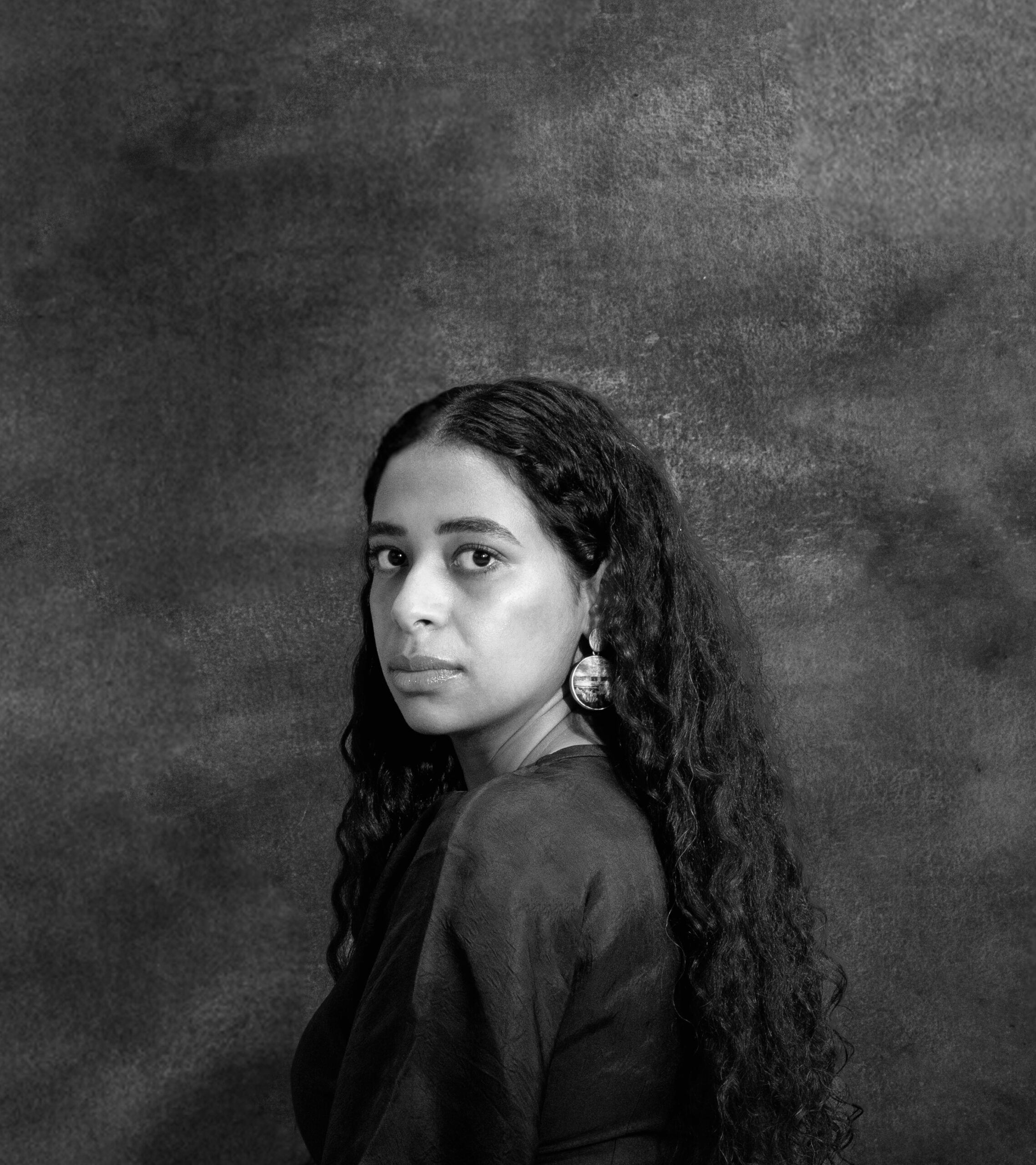
Painting, embroidery, jewellery: Egyptian designer Fatma Mostafa moves freely between disciplines, creating miniature works of art inspired by nature, memory and her native Cairo. Fresh from receiving the Accessories Talent Award at Paris’s Institut du Monde Arabe, she talks about the beauty of craftsmanship, the importance of slowing down and the city that continues to shape her imagination.
You recently received the Accessories Talent Award from the Institut du Monde Arabe in Paris. Having already won the Fashion Trust Arabia Prize in 2022, what does this new recognition represent at this stage of your career?
Winning Fashion Trust Arabia in 2022 opened doors for me and gave me the opportunity to grow, both creatively and professionally. At the beginning of this year, being the winner of the Maison Mode Méditerranée award in Marseille, followed now by the Accessories Talent Award from the Institut du Monde Arabe, has given my brand further credibility. Having my work recognised by such respected names in the jury and fashion industry is very encouraging, especially in an industry and a time that can be extremely challenging for independent designers. It reassures me that I am moving in the right direction and gives me the confidence to continue developing my practice in my own way.
Your jewellery sits somewhere between painting, embroidery and sculpture. Do you consider yourself an artist who makes jewellery, or a jewellery designer who creates wearable works of art? Does the distinction even matter to you?
I studied oil painting before moving into embroidery and jewellery, so these disciplines have always influenced one another in my practice. Jewellery has its own particular challenge: a piece must be artistic while also fitting the body comfortably and becoming part of its movement. I love this encounter between two worlds, where artistic expression meets the practical intimacy of something worn. Over time, my practice has also expanded into objects and sculpture, exploring how my work can exist in relation to both the body and a space. Ultimately, I see myself as a maker. I love creating, and I don’t want to limit that impulse to a single discipline.
Your mother introduced you to embroidery when you were a child. How has this early experience shaped your creative identity, and what does the act of working slowly, stitch by stitch, mean to you in an industry obsessed with speed?
Embroidery was one of the first crafts I learned from my mother, and it remains a very personal part of my practice. Each stitch requires patience, attention, and care. We live in a fast-paced world where sustainability and reducing waste are widely discussed, yet in reality, the industry still often demands that designers produce more and faster. Sometimes these values remain just words. I try to stay true to my belief that handmade objects have their own value and rhythm, one that cannot simply be accelerated. This is what makes them unique in a world that is constantly rushing. For me, working slowly is not just a process; it is a way of respecting the material, the craft, and the time each piece deserves.
From Monet’s Water Lilies to the landscapes of Egypt, nature plays a central role in your creations. What draws you to these particular images, and how do you translate something as vast as a landscape into an intimate object?
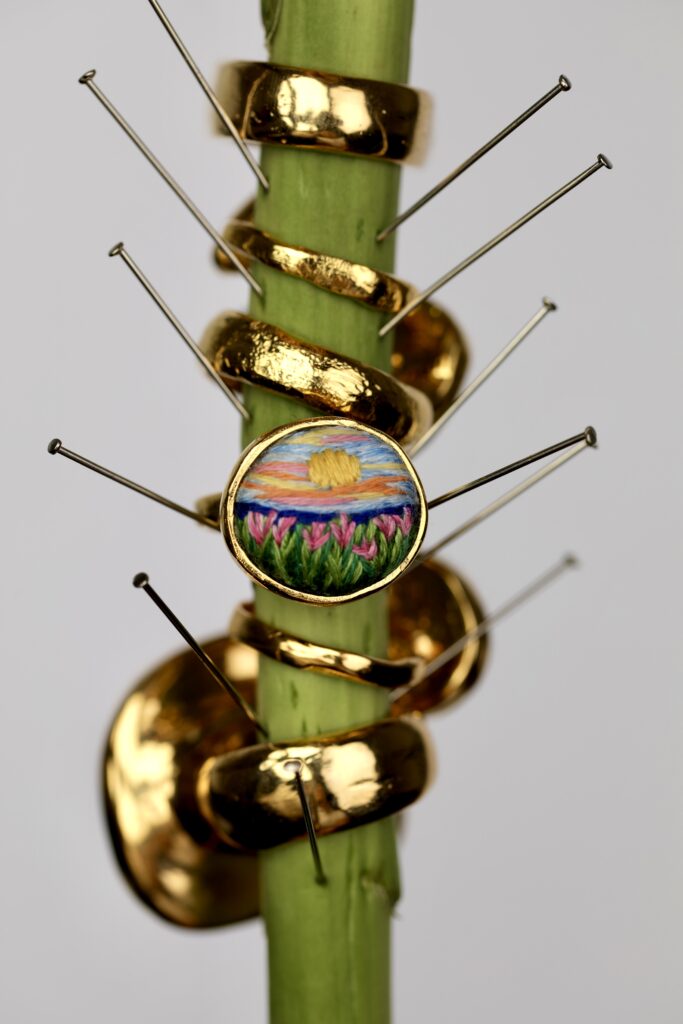
My background in oil painting made me attentive to colour, light, and the emotions a landscape can carry. My Water Lilies collection connects Monet’s paintings with a place in Cairo where I used to go sketching and observing lotus flowers: the Orman Garden. These personal memories meet my admiration for the way Monet captured the atmosphere of nature rather than simply reproducing it. In my work, I try to translate the landscapes I see while travelling, locally or abroad, into intimate objects through embroidery, metal, and texture. A landscape becomes a fragment of a larger world, something you can carry close to your body. I am interested not only in how a place looks, but in how it makes us feel and the memories it leaves behind.
Jewellery has always carried a strong symbolic and emotional significance in Egyptian culture. How do you approach this heritage without falling into nostalgia? And do you think contemporary Arab designers are finding new ways to tell their own stories?
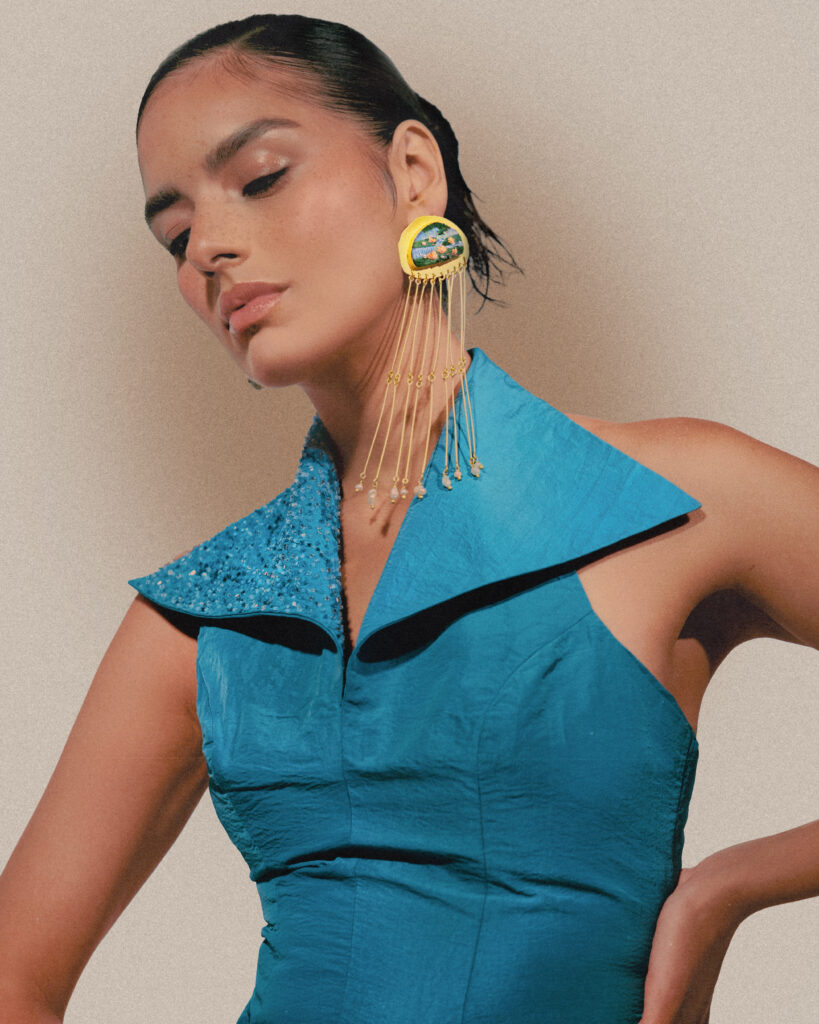
Growing up in Egypt, visiting the gold souks and seeing jewellery across different periods of our history has been a great source of inspiration. From ancient Egyptian and Islamic traditions to the distinctive jewellery of different communities, each region has its own visual language, whether in Upper Egypt, Nubia, or Siwa. These traditions have taught me not to copy or recreate what already exists, but to learn from their way of thinking and find my own language through the elements that inspire me. The same is true of craftsmanship in Egypt in general. So I approached jewellery in my own way, by bringing together two crafts: hand embroidery and jewellery making.
I am proud to be part of a generation of Arab designers bringing our heritage into contemporary creation. Our region’s cultural richness and civilisations give us a strong foundation to create from; our history is like a backbone, giving us identity, strength, and a sense of belonging. We are not starting from nothing; we are growing from a deep cultural history that continues to inspire new possibilities. I see so much talent in our generation, with designers elevating their heritage into contemporary and internationally relevant work. I believe we deserve greater visibility and support to continue growing.
You live and work in Cairo, a city of extraordinary contrasts, energy and visual intensity. How does it influence your imagination? Is there a particular place in the city that you return to for inspiration?
Cairo is a city where the extraordinary becomes part of everyday life. You can be driving and suddenly see the Pyramids, one of the Seven Wonders of the Ancient World, or listen to music while sitting by the Nile. History is not something distant here; it surrounds you, living alongside the chaos, the energy, and the rhythm of everyday life. I grew up in Sayyida Zeinab, in the heart of historic Cairo, surrounded by the intricate motifs of architecture, and by the warmth and kindness of its people. I think growing up in this environment shaped my eye for composition, detail, and unexpected combinations. Cairo is full of contrasts, and perhaps this is what finds its way into my work: the meeting of different materials, textures, histories, and disciplines. I cannot choose one place for inspiration because the whole city, with its beauty, intensity, and challenges, has become part of me. Cairo has taught me to find inspiration in the unexpected, even in the most ordinary moments and in the most challenging ones too. It is a city that is always challenging me.