
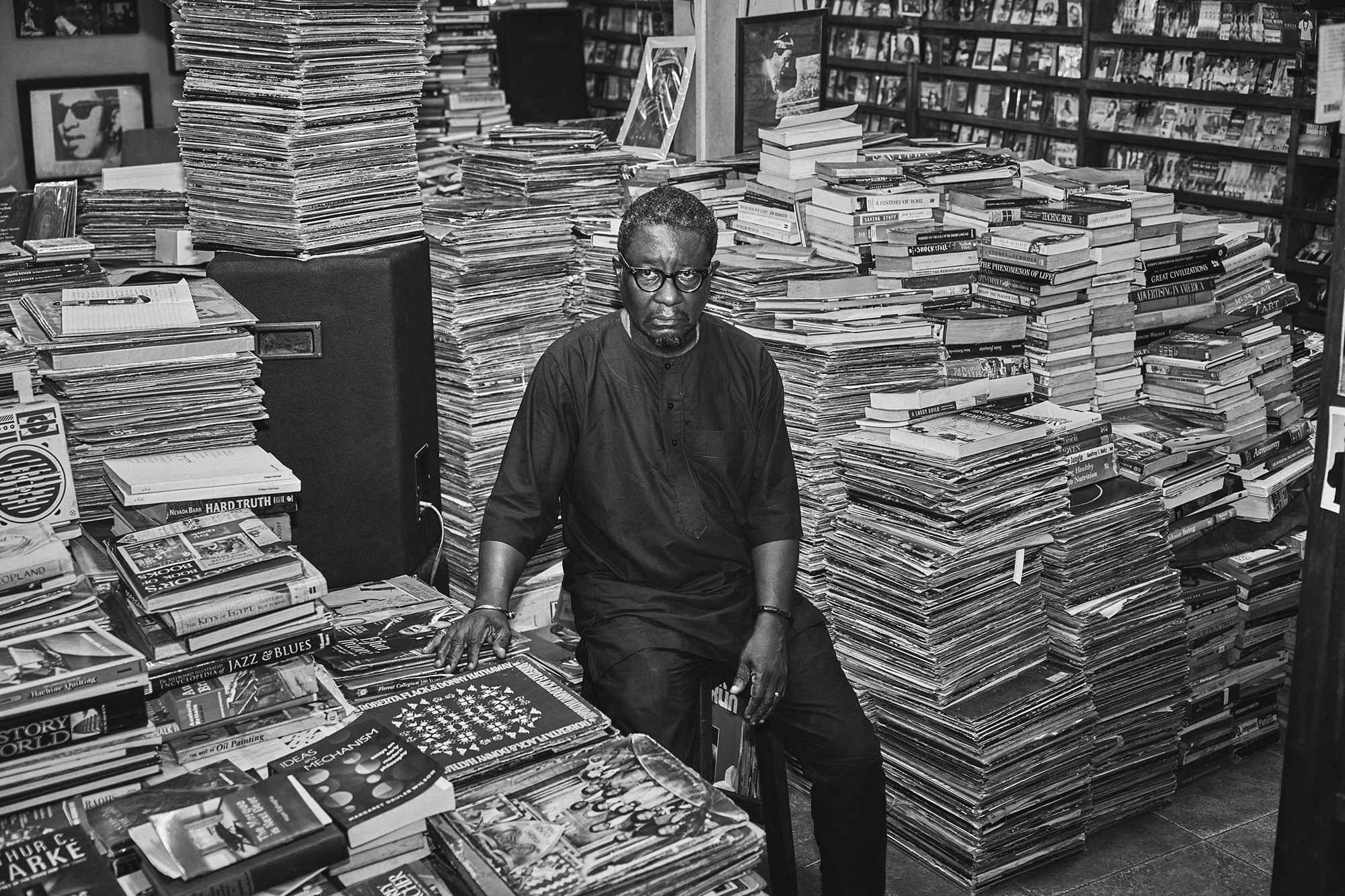
In a city where noise can drown out nuance, Jazzhole has long been a refuge, a portal into the sonic, intellectual, and spiritual depths of the Black world. Founded by Kunle Tejuoso in the early 1990s, the iconic Lagos bookstore and record shop offers more than books and vinyls; it offers perspective, memory, and resistance. Rooted in his mother’s legacy (she opened the legendary Glendora bookstore 50 years ago), Tejuoso’s Jazzhole is both a sanctuary and a living archive. In this conversation, he opens up about curation, cultural responsibility, and why, if he had to choose, he’d take books over beats.
What was your original vision when you founded Jazzhole?
I’ve always been a music collector. Over time, I became increasingly drawn to the serious side of Black music, jazz, particularly. I was also fascinated by African music, not just Nigerian, but from across the continent and the diaspora. Back then, there was no internet, no easy access to all this richness. So I imagined a small, cultural store that could reflect the breadth of the Black world. Music, yes, but also literature. Books that lean toward the serious, the thoughtful. That’s why we named it the Jazzhole. It started out in a much smaller space than this one. The idea was to offer an alternative, something beyond the mainstream.
What kind of people have you encountered over the years through the store?
Everyone. All types. People from all walks of life. Some names you’d recognize: my mum says even Muhammad Ali once passed through. But it’s more than that. You meet people who read newspapers here every day but can’t afford to buy books. You meet those who studied abroad but got lost along the way. Under the military regimes, some people were imprisoned, and my mother would secretly pass them books through security agents. That’s what we offer: not food, but books as sustenance.
How do you curate your collection, both books and music?
My focus has always been to enlighten society. I look for books that are intellectually or philosophically uplifting: history, politics, literature. I want people to walk in and walk out feeling mentally stimulated. Same goes for music. While I might sell some commercial titles to keep the lights on, my heart is in the serious stuff: jazz, world music, even a bit of classical. I think of it like sharing my personal collection. That’s the goal: offering an experience that lifts people out of the tension of Lagos and into a broader, more imaginative world.
If you could stage a meeting between a writer and a musician, alive or dead, who would they be?
I have a deep connection with African American music. One artist I truly admire is Yusef Lateef. He lived in Nigeria for a while. A very spiritual man: Muslim, soft-spoken, very thoughtful. I’d love to see him in conversation with a writer who carries that same clarity. Maybe Chimamanda Ngozi Adichie. She represents Nigeria so elegantly. She never shouts, but she’s firm. She sees nuance. I may not agree with her on everything, but I always watch her interviews. She gets it.
What are the biggest challenges of running a bookstore and record shop in Lagos?
Where to start? Currency fluctuations, import costs. We bring in most of our stock from Europe and America. You want to be affordable, but you also need to survive. I’m not in it to make a fortune. I’m socially inclined. Rent is tough. Capital is a constant issue. It’s the same struggles every small retailer faces, amplified by the local economy.
How do you feel Nigerian music and literature are evolving?
There’s a wave of pop entertainment that’s opened a lot of doors, and that’s great. But I hope it paves the way for more serious music, too. I want to hear messages. Not just club tracks, but consciousness. Not in a boring way… just something with depth. Music can educate. Artists like Fela knew that. I think young musicians today underestimate the power they have. Yes, they have huge followings online. But what if they used that power for something bigger than fashion and cars? Music can touch humanity. That matters.
And literature?
It’s the same. We’re finally seeing the world pay attention to Nigerian voices: writers like Chimamanda, younger poets, essayists. There’s momentum. For once, the West is listening. We have numbers. We have diaspora. We have energy. Now is the time to tell our stories, in our own words.
If I asked you to pick one record and one book that best capture Lagos, what would you choose?
For music, it has to be Fela. No one has translated the spirit of Lagos better. If I had to pick one album, it might be Beast of No Nation. That record took his message global. It wasn’t just about Nigeria anymore. It was about global oppression, injustice. That’s the kind of music I’m talking about. Music with weight. For literature? I’d say Chimamanda again. Her presence, her poise… she embodies the complexity of Nigeria.
Can you recall a surprising encounter that happened here in Jazzhole?
Yes. Salif Keita. I’ve sold so many of his CDs over the years. Then, one day, his manager, who’s a friend, brought him into the shop. I lost it. I was so happy. He was kind of confused Like, why is this guy so emotional? But it was a big moment for me.
If you had to choose between selling only books or only music for one year, what would it be?
Books. Hands down. Music lives in my head, but books, they’re necessary.