
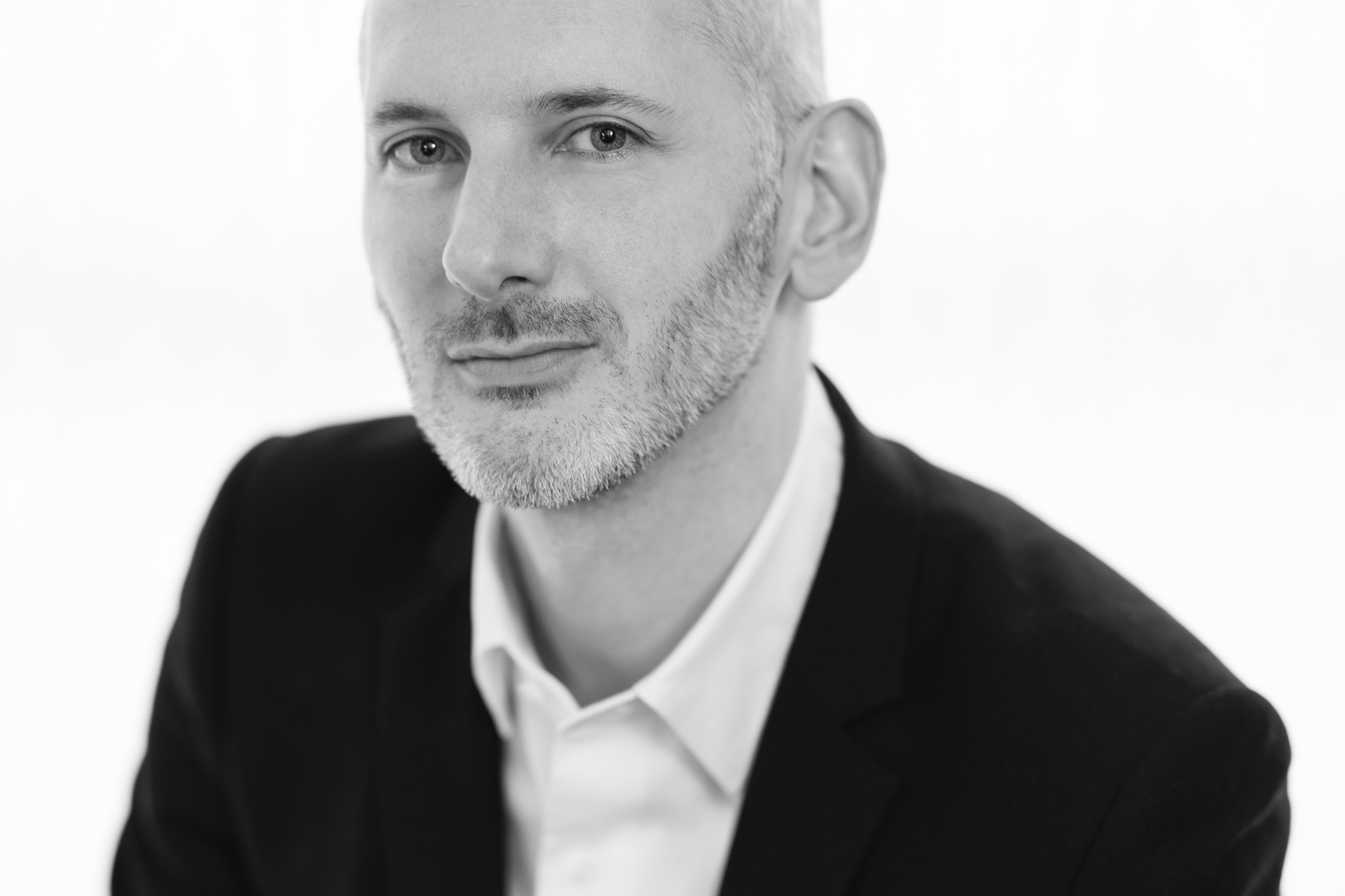
Author of some of the most striking fragrance trails in contemporary perfumery, Quentin Bisch has established himself as one of the most influential creators of his generation. Through his creations, he has received numerous distinctions, yet he continues to move forward without certainties. The French perfumer prefers questions to answers, detours to fixed formulas.
A perfumer at Givaudan, he is behind some of the most talked-about fragrances of recent years: Nomade for Chloé, Fleur Narcotique for Ex Nihilo, Angel Muse, as well as creations for Jean Paul Gaultier, Diptyque and Marc-Antoine Barrois. Several of these scents have been recognised by the Fragrance Foundation in France and internationally, gradually establishing Quentin Bisch as one of the leading figures of contemporary perfumery. Ganymede, which has become almost cult within independent perfumery, stands among the emblematic creations of this journey, while his compositions for Jean Paul Gaultier have received further recognition in recent years. Yet when speaking about his craft, Quentin Bisch rejects any notion of absolute mastery. Even today, he moves through his work the same way he creates: through doubt, movement and exploration.
Your early years, first in Strasbourg and then in London, exposed you very early on to the world of fragrance. Which memories from that time still resonate today?
It is difficult to say how much of it still resonates, but I can only imagine that it works unconsciously. My earliest olfactory revelations were my parents’ perfumes. I obviously remember Shalimar. I remember Derby by Guerlain worn by my father, alternating with Vétiver, also by Guerlain, and then Pour Monsieur Concentré. I found that perfume fascinating and later discovered that another version existed, Pour Monsieur. Very early on, I began to understand that a fragrance could exist in different variations, different concentrations, all built around the same idea. Then there were my mother’s perfumes: Loulou, Poison, and others. She changed frequently. I think it awakened both my taste for beautiful perfume and the idea that scents can evolve.
When you think of your mother, you do not think of a single perfume then?
She remained faithful to Shalimar, which will always be her perfume. But even today, she continues discovering new things.
Beyond perfume, which childhood smells stayed with you?
In Strasbourg there was the smell of fir trees from the Christmas market. I also remember paint at nursery school. Then London arrived. I remember cookies in the Underground. Tar melting in summer in the square near my school. And above all, peeled cucumbers around eleven in the morning, prepared for the school canteen. The smell would rise all the way into the classroom. It stayed with me because it was a period of instability in my life. I was not doing very well and I associated that fresh cucumber smell with something unsettling.
Does that association still stay with you today?
Not as a trauma. When you become a perfumer, you eventually begin to see all the possibilities within smells, even those considered negative. But if I smell peeled cucumber very early in the morning, in winter, then yes, it can still trigger something. A cucumber in a kitchen in summer, however, does absolutely nothing to me.
Yet you did not move directly into perfumery.
No. I first tried the conventional path: chemistry. But I was unable to complete those studies. After that failure, I turned towards performing arts. I spent five years studying theatre analysis: literary, philosophical, sociological and ethnological analysis. It was not an acting school, but a way of thinking about theatre as a whole.
How did you find your way back to perfume?
At the end of my studies, my professors wanted me to continue. I told them: it is now or never, I need to find out whether perfumery is possible. Perfume had remained my first love. I wrote to perfumers and asked for meetings. Many welcomed me and gave me their time. Then I met Michel Almairac at Robertet. He secured me an internship in Grasse. At the end of it, he hired me as a perfumer’s assistant. That year proved decisive because Jean Guichard, who was then director of the Givaudan school, had told me: come back once you have started building your olfactory memory. That year was devoted to exactly that.
How would you define your style?
I am completely incapable of doing that. I chase certain things: clarity, surprise, emotion, novelty, something that takes us elsewhere or makes us see differently. Do I achieve it? I hope so. But I think others are better placed to answer that.
How do you continue to surprise yourself?
It is actually very simple: you have to leave your comfort zone. If I stay inside it, the result often becomes uninteresting. You have to put yourself at risk, go on an adventure, start searching. I am lucky in one respect: the blank page does not scare me. Quite the opposite, it attracts me. What frightens me much more is when a formula begins to lock itself, when it becomes too defined, too fixed, too finished. It is far more interesting when there are still open points left, still questions.
Do you doubt a lot?
I am never sure of myself. Or very rarely. I operate more through questioning. I am more often waiting for answers than actually holding them. I only move towards hypotheses, opening paths, opening possibilities. That is also why finalising a formula sometimes makes me anxious. Often, I feel we are not there yet. I have almost never had the certainty that a perfume was truly finished.
Your work seems to be a constant balance between creation and compromise.
Yes. I often picture a blade of grass in the wind. It remains itself, yet its appearance changes completely depending on the direction of the wind. You have to be the reed, not the oak. If you refuse movement, eventually you break. For me, the challenge is to follow the wind while keeping a strong singularity. Because if your vision is gradually emptied of its substance through compromises, you can end up with something that has lost its soul without even realising it.
If you had to create a perfume for a city?
Every city can be interpreted in a thousand different ways. I have just returned from Japan, from Shōdoshima. I would perfume the port of Tonoshō. There was iodine, roasted buckwheat, a late-summer softness. A scent that felt almost Mediterranean even though it was early autumn. There were flowers in the air, almost acacia-like notes, hay, freshly cut grass. Perhaps I would create a night in Tonoshō: a soft night with iodine, something roasted, that feeling of suspended springtime.
What is your view on artificial intelligence?
I use it because the software we work with already uses it. It speeds up calculations and simplifies certain steps. But yes, it frightens me. I do not like it very much because it accelerates things, and I do not like acceleration. It gives answers, whereas I am far more interested in the journey and in the questions. Finding the answer quickly matters very little to me. I would almost rather never find it and lose myself along the way. The more time I lose, the more I lose myself, the fewer answers I have… the more interesting it becomes.