

In a world of perfumery often driven by storytelling, Aurélien Guichard champions a radically different approach: starting with the raw material, and the raw material alone. Born in Grasse into a family of perfumers and artists, he is now one of the very few creators who cultivates some of the flowers used in his own fragrances. With Matière Première, he advocates a clear, contemporary olfactory language in which sophistication emerges from simplicity.
Founder and perfumer of the French house Matière Première, Aurélien Guichard occupies a singular place in contemporary perfumery. Born in Grasse, the historic birthplace of perfume, he comes from a long line of perfumers but chose to take his relationship with raw materials even further. In 2016, he planted nearly 25,000 Centifolia rose bushes in the south of France, becoming the first perfumer-founder to produce some of the ingredients he uses himself.
Before launching Matière Première in 2019, Aurélien Guichard created numerous fragrances for major international houses, including Narciso Rodriguez, Issey Miyake, Gucci, Burberry and Versace. With his own brand, he has developed an approach that feels almost like a manifesto: revealing the intrinsic beauty of an ingredient by working with it in unprecedented proportions, without distorting its nature. For CITY, he reflects on his childhood in Grasse, his relationship with creation, the birth of Matière Première, and his vision of a perfumery that is at once radical, modern and deeply human.
You are one of the very few perfumers who cultivates your own flowers. How does that change your relationship with raw materials?
Yes, I am the only one doing it. For me, the relationship with raw materials is a quest for authenticity and reality. Anchoring a creation in something real is what gives it meaning. I come from Grasse and grew up surrounded by people who cultivated roses and jasmine. My grandparents did it. From a very young age, I was exposed to harvests, craftsmanship, and a culture that is largely transmitted through gesture and practice. I also come from a family of perfumers and sculptors. My mother was a marble sculptor. There were flowers, stones, Carrara marble. What connected all these creators was the material itself.
So you never separate creation from material?
What interests me most about material is texture. Its tangible quality. Its connection to something real and concrete, something that can be physically experienced.
How did the idea of cultivating your own roses come about?
After spending fifteen years creating fragrances for other houses, I felt the need to return to something that had been part of my childhood. In 2014, I launched a Centifolia rose farm. Initially, I simply intended to use these roses in projects I was developing for various brands. Then, while watching the plants grow alongside two close friends and partners, we asked ourselves a question: why not create a house that speaks directly about the material itself? It was by watching those rose bushes grow that the idea of Matière Première truly took root.
You have often said that raw materials are at the heart of your work. What do you mean by that?
When I work for a brand, I am serving its identity. I try to understand its DNA, its history and its culture. With Matière Première, it is different. I am serving the material. I often say there is no room for inspiration in my work for Matière Première. That may sound paradoxical, but it is a very factual process. My role is to reveal the beauty of a material and transform it into a fragrance.
How did that concept become a brand?
I had many friends working in fashion, art and design who told me they did not wear perfume. When they came to visit me, I would let them smell raw materials. They loved them. Yet they disliked the fragrances they found on the market. I began wondering whether there was a disconnect between the incredible beauty of raw materials and the way they were being used in perfumes. I started creating compositions that respected the material more closely. People immediately recognized the ingredient. They did not feel as though they were wearing a mask or disguising themselves. Then they started receiving compliments. They came back asking for more. That was when I realised something meaningful was happening.
How does an idea become a fragrance?
For Matière Première, everything begins with a material I deeply love. I ask myself how I can treat it differently, how I can use more of it than is usually done. This notion of overdose is essential. Take Radical Rose. It is the fragrance containing the highest concentration of Centifolia rose in the world. When you use that much rose, certain less obvious facets emerge, notably a honeyed aspect that can feel slightly old-fashioned. The challenge is to preserve this extraordinary richness while creating something modern, vibrant and contemporary. With Vanilla Powder, on the other hand, I had a very precise mental image: a vanilla pod covered in white, surrounded by a cloud of powder. I wanted to take vanilla somewhere completely different from where it is usually found. At Matière Première, the name always comes after the fragrance. The perfume is created first, and the name then explains the creative process.
Can a fragrance reflect a place, a light, or a memory?
That is not something I try to do. On the contrary, I try to remain as factual as possible. The magic should happen between the person wearing the fragrance and the fragrance itself. Once I have created it, it no longer belongs to me.
So you never try to provoke a particular emotion?
No. Never. I simply try to share the beauty of an ingredient. What people do with it afterwards is entirely up to them.
Your approach seems almost counter to the current market.
I do not think the market is saturated with quality. What often distinguishes great houses is the existence of a genuine style. When creative decisions are made by a living creator rather than by market research, a certain coherence emerges. At Matière Première, I create the fragrances, but I also oversee the artistic direction. That coherence is important.
We also have a very universal approach. We do not want to create global fragrances. We want to create universal fragrances. Anyone, anywhere in the world, can appreciate the beauty of an apple or a rose. We believe more in this human and universal perception of ingredients than in marketing segmentation.
Is there a material that challenged you for a long time?
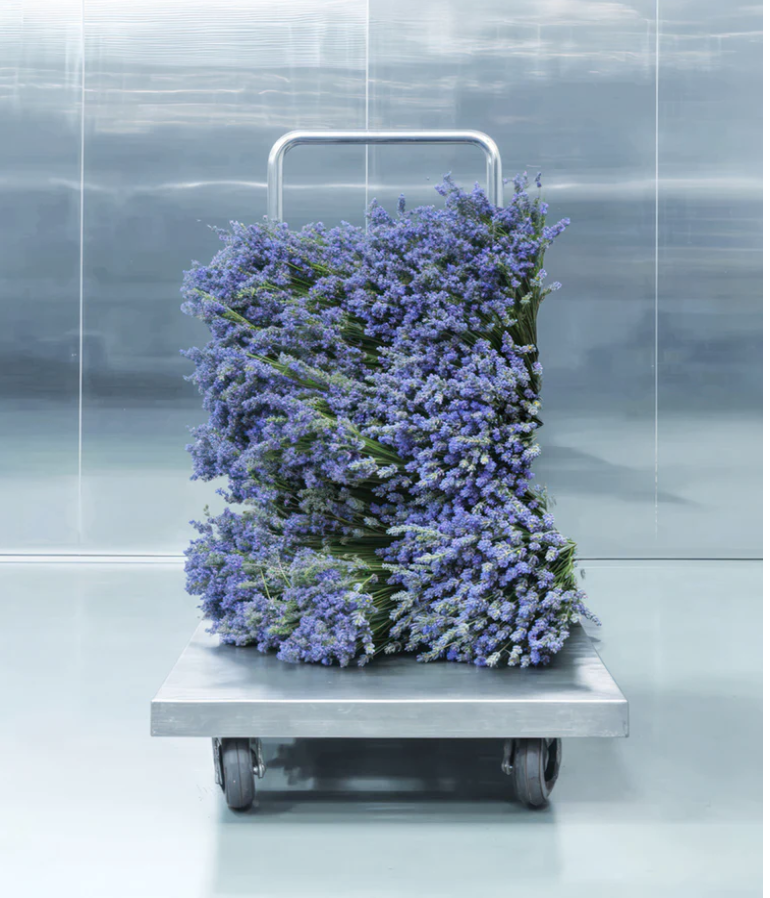
Until recently, lavender. I worked on it extensively. With Metal Lavender, I wanted to show that it is possible to create a lavender fragrance that feels modern, youthful and capable of breaking preconceived ideas. But in the end, every material offers some resistance. Even those I have already worked with. If I were to revisit them today, I would probably approach them differently.
And is there a scent you would not dare explore?
No. I think the only real limit is sometimes imagination. There is, however, one thing I find truly disappointing: a fragrance that disappears. When someone wears a perfume, they should be able to enjoy that promise throughout the day. For me, that is absolutely essential.